

The use of artificial intelligence in business keeps growing. Until recently, most companies used AI to answer questions and generate content. Now it is being built directly into daily operations: reading invoices, flagging anomalies, routing approvals, and answering questions from internal documents. That raises a practical question: does every company need it?
AI-powered custom software is an application built specifically for one company's business processes, with AI capabilities embedded inside it, such as reading documents, predicting outcomes, recommending actions, or answering questions from internal data. Unlike off-the-shelf AI tools, the AI here connects directly to the company's own data, approval flows, and existing systems.
This guide explains how it works, when a company needs it, where it is used, what to consider before building it, and how to choose a development partner.
What Is AI-Powered Custom Software?
AI-powered custom software combines two things. Custom software is an application designed around a company's workflows. AI is the capability that lets the application understand data, recognize patterns, and support decisions. The result is a system that does not only store and display data but also takes part in the business process.
AI-powered custom software vs AI SaaS
AI SaaS tools give general AI capabilities to any customer. AI-powered custom software is designed around one company's data, processes, and systems.
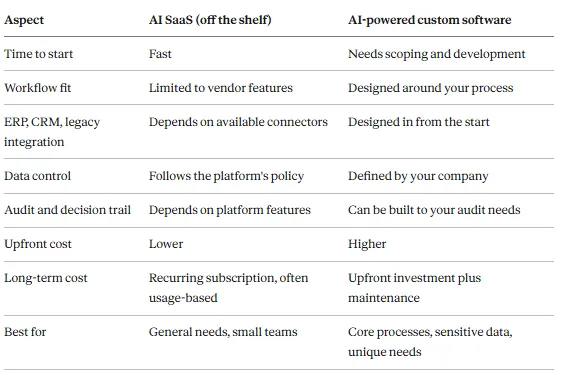
If the need is generic and the data is not sensitive, AI SaaS may be enough. If the process is core to the business and touches many systems, custom software usually makes more sense. For the wider trade-off, read Custom Software vs Off-the-Shelf (in Indonesian).
AI-powered custom software vs AI-assisted development
The two terms are often confused. AI-assisted development means developers use AI to build software faster, as explained in How AI-Assisted Development Works (in Indonesian). AI-powered custom software means AI is part of the product that employees or customers use. A project can use both, but they solve different problems.
When Does a Company Need AI-Powered Custom Software?
Not every company needs it. These situations usually point to custom software rather than an off-the-shelf tool.
Your data is sensitive or must stay under your control
With off-the-shelf AI, data often has to leave for another party's platform. With custom software, the company decides where data is stored, who can access it, and which model is used. For sensitive data, the architecture can use a private LLM and Private RAG.
AI must work inside systems you already run
AI that stands alone only gives answers. AI connected to the ERP, CRM, or internal databases can act: drafting a document, flagging an anomaly, or triggering an approval in the system your team already uses.
Your workflow has rules a generic tool cannot follow
Every company has its own approval rules, terminology, and exceptions. With custom software, those are designed in from the start, so teams do not need to change how they work to fit the tool.
You need audit trails and role-based access
Access control, activity logs, and decision trails can be built into the application instead of added later.
When AI SaaS is enough
If the task is general, such as drafting text or summarizing public documents, and no sensitive data or system integration is involved, a ready-made tool is usually faster and cheaper.
Examples of AI-Powered Custom Software in Enterprises
These are among the most common applications built for enterprise systems. The wider range of application types is covered in Types of Custom Software for Enterprise.
1. Document and invoice automation
AI reads incoming invoices and documents in different formats, extracts key fields, matches them against purchase orders, and flags patterns that look unusual before payment is released. The finance team reviews the exceptions instead of every document. The same approach applies to contracts, delivery notes, and other documents that enter an approval workflow.
What to prepare: sample documents in all common formats, the approval rules, and the systems the extracted data must reach.
2. Asset management and maintenance
In a fixed asset management system, repair history and usage data can be used to estimate which assets need maintenance first. Combined with QR code or RFID tracking and a mobile audit app, the system keeps asset data current while AI helps prioritize. See Fixed Asset Management System for Enterprise.
What to prepare: an asset register, maintenance records, and a clear definition of what counts as a failure.
3. Internal knowledge management
Employees ask questions in plain language, and answers are drawn from the company's own documents such as policies, SOPs, and technical manuals, with existing access rights still applied. This is typically built with Private RAG so that confidential documents stay inside the company's environment.
What to prepare: organized source documents, clear ownership of each document, and rules on who may see what.
In all three examples, important decisions can still depend on human approval.
How Is AI-Powered Custom Software Developed?
The process follows normal custom software development, with extra steps for data and accuracy testing.
1. Define the use case
Pick one process that is clear, repetitive, and measurable. "AI for everything" is not a use case.
2. Assess data readiness
Check whether the data exists, is clean enough, and may be used. Many AI projects stall at this step.
3. Build a prototype and validate it
Test the idea on real data at small scale before building the full system.
4. Develop and integrate
The AI becomes part of the application, connected to existing systems, with access control and activity logs.
5. Test accuracy and security
Beyond standard application testing, AI results are tested on real data and acceptable error limits are defined before go-live.
6. Go live and monitor
After release, AI performance is monitored and improved, because data and needs keep changing.
Have a process you want AI to help with but are unsure where to start? Contact the CODE.ID Team to discuss the most sensible first use case.
What to Consider Before Developing AI-Powered Software
Data quality and readiness
AI is only as good as its data. Scattered, inconsistent, or incomplete data will reduce results.
Security and compliance
A company remains responsible for customer data under laws such as Indonesia's Personal Data Protection Law (UU PDP). Decide what data AI may process, where it is stored, and who can access it. Hosting choices matter too; see Indonesia's Data Centers Are Expanding.
Accuracy and wrong answers
AI models can give answers that sound convincing but are wrong. For high-impact decisions, design a human approval step and measure accuracy before go-live.
User adoption
An application nobody uses delivers no value. Involve users from the start so the workflow matches how they actually work.
Cost and timeline factors
There is no single number, because scope varies. The biggest factors are:
the number and complexity of use cases;
data readiness, including cleaning and consolidating sources;
the number of systems to integrate;
security and compliance requirements, such as private models and audit trails;
the accuracy level required and how much testing it takes;
maintenance after go-live.
A realistic estimate usually becomes possible after a discovery phase. The safest way to start is with one use case.
Choosing a Development Partner for AI-Powered Custom Software
Ask a prospective partner these six questions:
Do they build software, or only AI models?
How will they integrate with our existing systems?
Where is data stored, and is a private model available for sensitive data?
How is AI accuracy measured and tested before go-live?
What support and maintenance follow the release?
Do they have comparable systems already running?
For general vendor selection, see How to Choose the Best Software House in Jakarta (in Indonesian). To understand where a vendor's speed-up with AI can become a risk, read Vibe Coding vs Software House (in Indonesian).
Build AI-Powered Custom Software with CODE.ID
CODE.ID builds enterprise custom software with AI capabilities inside, from procurement systems with invoice OCR and anomaly detection, to asset management with maintenance prediction, to document processing. The architecture is designed to connect to your ERP, CRM, and existing systems. For AI and infrastructure needs, see our AI and Cloud solutions.
Have an idea or a process you want AI to help with? Our team can assess feasibility, choose the first use case, and build it to enterprise standards.
Considering AI-powered custom software for your company?
Ready to Build AI-Powered Custom Software?
Discuss your needs with the CODE.ID team, from choosing the first use case to a production system built to enterprise standards.